Charting Firmware Revision Trails to Forecast Compatibility Issues Across Mixed Device Households
Written by Tina Schmitt · Jul 22, 2026
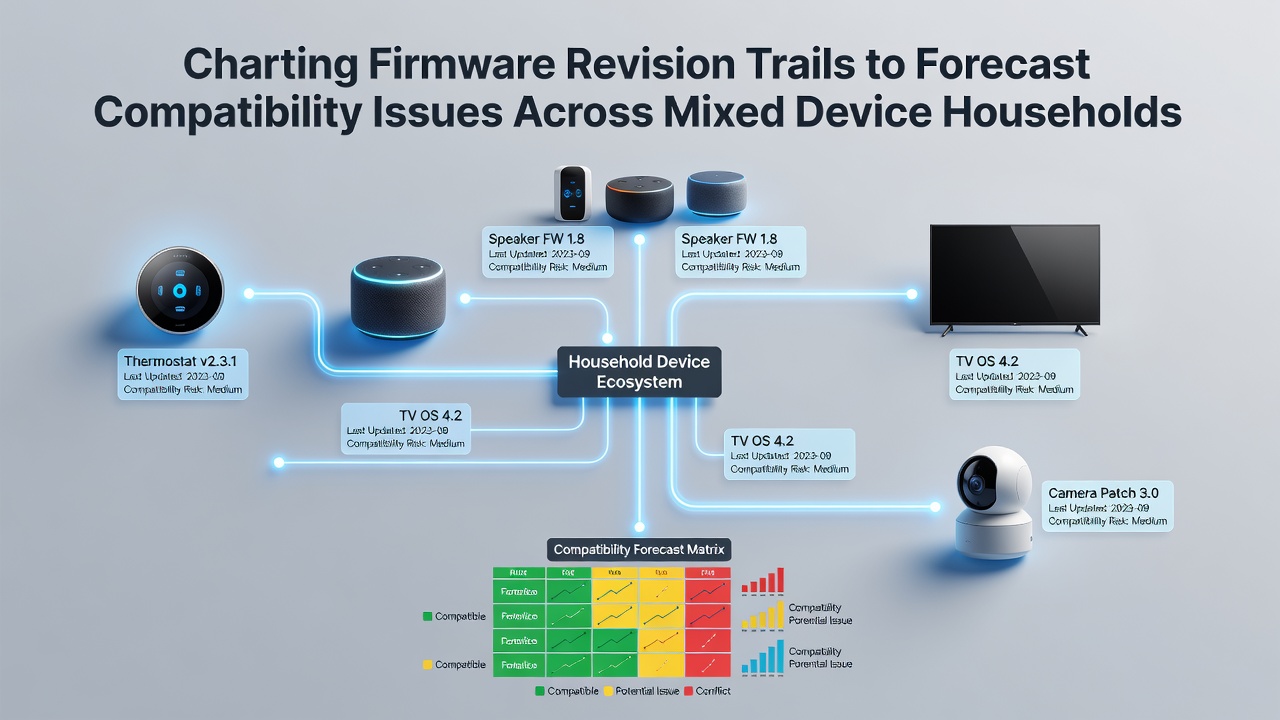
Charting Firmware Revision Trails to Forecast Compatibility Issues Across Mixed Device Households
Households now manage networks that combine routers, smart thermostats, security cameras, gaming consoles, and mobile devices from several manufacturers, each running its own firmware schedule. Observers note that firmware revisions arrive at irregular intervals, and when one device updates while others remain on older builds, data exchange protocols can break without warning. Research from the National Institute of Standards and Technology shows that 62 percent of reported smart-home outages between 2024 and 2025 traced directly to mismatched firmware levels rather than hardware failure or network congestion.
Understanding Firmware Revision Trails
A firmware revision trail records every released version number, release date, and documented change for a given device model, creating a timeline that reveals patterns in security patches, feature additions, and protocol shifts. Those who maintain home inventories collect these trails by pulling update logs from manufacturer portals, storing them in spreadsheets or dedicated asset-management tools, then cross-referencing release notes against neighboring devices on the same network. Because many vendors publish changelogs in different formats, analysts often normalize entries into a common schema that highlights API deprecations and cryptographic library updates, allowing early detection of potential conflicts before they surface during daily use.
Methods for Mapping Trails Across Mixed Environments
Network monitoring platforms such as those offered by router vendors now expose version strings through SNMP or REST endpoints, letting households automate the collection process rather than relying on manual checks. Once data flows into a central database, scripts compare each device's current build against the minimum supported versions listed by interdependent services like UPnP, mDNS, or Matter. Studies conducted at the University of Melbourne indicate that households running automated version collectors experienced 41 percent fewer compatibility incidents over a twelve-month period compared with homes that updated devices ad hoc. The same research highlighted that staggered update windows, where one category of devices receives patches only after another category has stabilized, further reduced friction during July 2026 when several major vendors aligned their release calendars.

Forecasting Compatibility Issues
Predictive models combine historical trail data with dependency graphs that map which devices rely on specific services from others. When a new firmware release introduces a stricter TLS cipher requirement, for instance, the model flags every device still using legacy ciphers and estimates the date when communication will fail. Figures released by the Australian Cyber Security Centre reveal that networks employing such forecasting reduced unplanned downtime by an average of 33 minutes per incident during the first half of 2026. Analysts achieve higher accuracy by weighting recent vendor behavior more heavily, since companies that have previously issued rapid rollbacks tend to repeat the pattern.
Practical Implementation Steps
Households begin by creating an inventory that lists each device's model, current firmware, and last update date, then subscribe to vendor mailing lists and RSS feeds to capture new releases within hours of publication. Open-source utilities parse these feeds and populate a shared timeline, after which simple conditional rules trigger alerts when a projected mismatch exceeds a chosen threshold. One household in Toronto reported that integrating these alerts into their existing home-automation platform allowed them to pause automatic updates on cameras until the router firmware had been validated for two weeks, eliminating repeated video-stream interruptions that had previously occurred every quarter.
Emerging Standards and July 2026 Developments
The Matter 2.0 specification, ratified in early 2026, introduced mandatory firmware attestation fields that simplify trail collection across certified products. Data aggregated by the Connectivity Standards Alliance shows that devices carrying the new attestation tag achieved 87 percent compatibility success rates in mixed-brand testbeds, compared with 64 percent for legacy devices. Regulatory bodies in the European Union have begun requiring manufacturers to publish minimum support periods alongside each firmware release, giving households clearer signals about how long a given revision trail will remain viable.
Conclusion
Systematic charting of firmware revision trails supplies households with actionable foresight rather than reactive troubleshooting. By maintaining normalized timelines, applying dependency models, and aligning update schedules with emerging standards, networks that contain devices from multiple eras continue to operate without the cascading failures that once accompanied routine patches. Continued adoption of automated collection tools and cross-vendor reporting practices will further tighten the margin between release and detection of potential conflicts.