Coordinating Layered Backup Systems to Limit Exposure in Sudden Technology Shifts
Written by Noah Carter · Jun 13, 2026

Coordinating Layered Backup Systems to Limit Exposure in Sudden Technology Shifts
System transitions occur when organizations replace hardware, migrate operating systems, or shift workloads between environments, and these events create windows where data integrity can slip if backup mechanisms operate independently. Observers note that synchronizing multiple backup approaches reduces those windows by ensuring each layer references the same recovery points and maintains consistent versioning across local disks, network shares, and remote repositories. Research indicates that combining full backups with incremental and differential sets, then aligning them through centralized scheduling, prevents the common mismatch where one repository holds an older state than another.
Core Components of Multi-Strategy Synchronization
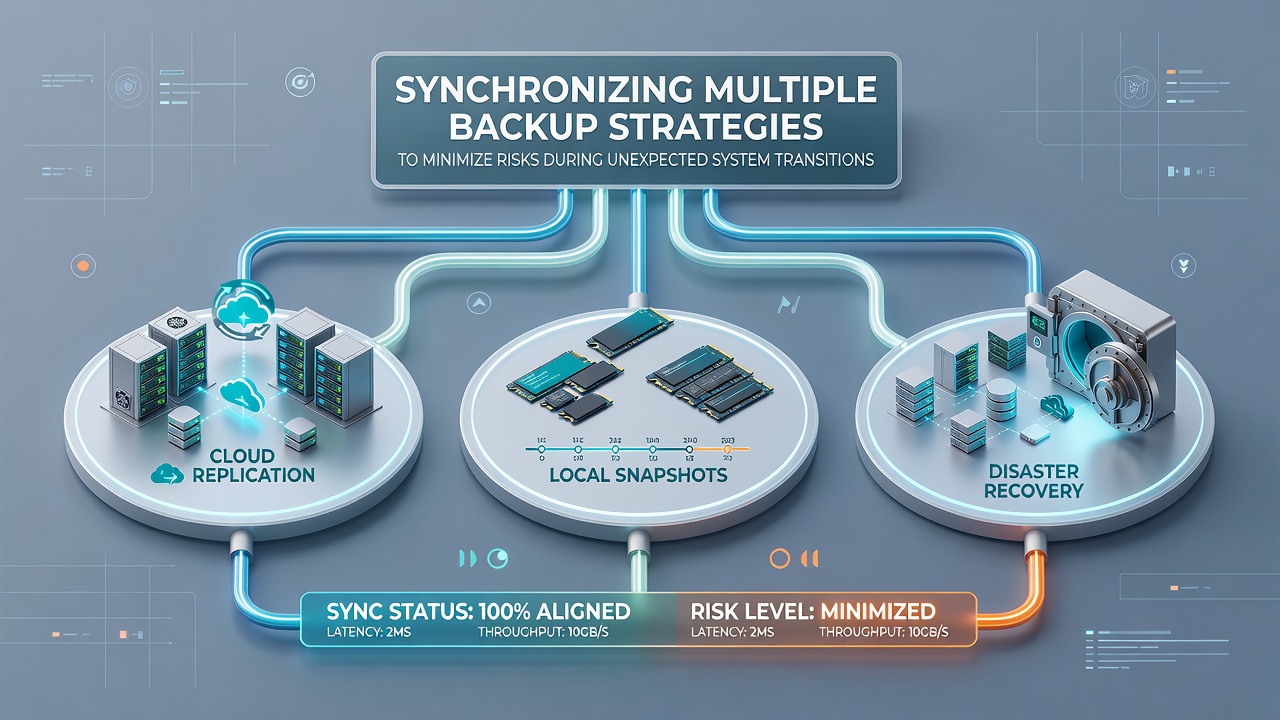
Effective coordination begins with mapping every backup type to a shared timeline so that full images, block-level increments, and file-level copies advance together rather than drifting apart. Data shows that tools capable of orchestrating these layers, such as scripted automation or dedicated orchestration platforms, track change journals across sources and apply retention policies uniformly. When a transition event approaches, administrators can trigger a final synchronization pass that verifies checksums on all active sets before the underlying hardware or software changes take effect.
Those who have examined enterprise environments find that the 3-2-1 rule gains additional resilience once each copy participates in the same synchronization cycle. One copy remains on-site for rapid restores, a second resides off-site or in cloud storage for geographic separation, and a third immutable snapshot protects against ransomware encryption. Because all three advance under coordinated schedules, recovery teams avoid the scenario where the off-site copy lags behind the local set by days or weeks.
Handling Timing and Automation During Transitions
Unexpected transitions often arise from hardware failures or security patches that force immediate reboots, leaving little room for manual coordination. Automated workflows address this by monitoring system health indicators and initiating pre-transition synchronization when thresholds indicate rising risk. Figures from industry reports reveal that organizations deploying such triggers experience fewer recovery-point gaps compared with those relying on fixed calendar schedules alone.
Scripts written in languages such as PowerShell or Python can query backup catalogs, compare timestamps, and force an incremental run if any layer has fallen behind. In June 2026 several research groups published updated guidance on embedding these scripts into change-management pipelines, noting that the added verification step adds minimal overhead while closing the most common failure modes during migrations.
Verification and Consistency Checks
Consistency checks form the final safeguard before any transition proceeds. Hash comparisons, file-count audits, and restore tests performed on a representative sample confirm that each synchronized layer contains identical data at the chosen recovery point. Experts have observed that performing these checks on a rotating subset of datasets, rather than the entire corpus every cycle, keeps resource consumption manageable while still surfacing discrepancies early.
According to documentation from the European Union Agency for Cybersecurity, organizations that integrate automated verification into backup orchestration report higher success rates when restoring after unplanned system changes. The same guidance emphasizes logging every synchronization event so that post-incident reviews can trace whether a mismatch originated from network latency, storage quota limits, or misconfigured retention rules.
Practical Integration Examples
One mid-sized logistics firm aligned its on-premises NAS backups with cloud object storage by routing both through a central policy engine that enforced identical retention windows. When the company migrated its ERP system to a new hypervisor platform, the synchronized layers allowed restoration of the prior day's state within two hours, avoiding the multi-day lag that had occurred during an earlier unsynchronized upgrade. Another case involved a university research cluster that combined weekly full backups with continuous replication to a secondary data center; after a sudden SAN controller failure in early 2026, administrators restored critical datasets from the most recent common snapshot without data divergence.
These examples illustrate how synchronization turns separate backup methods into a unified safety net rather than isolated silos. Observers note that the same principle applies to hybrid environments where some workloads remain on legacy hardware while others move to container orchestration platforms.
Conclusion
Synchronizing multiple backup strategies requires mapping each method to a shared timeline, automating verification steps, and embedding consistency checks into transition planning. Data from regulatory and research sources demonstrates that coordinated layers close recovery gaps that independent backups frequently leave open. Organizations that adopt these practices maintain continuous access to consistent recovery points even when hardware replacements or software migrations occur without advance warning.