The Hidden Cybersecurity Boost from Routine Hardware Renewals in Daily Computing
Written by Avery Schmitt · May 18, 2026

The Hidden Cybersecurity Boost from Routine Hardware Renewals in Daily Computing
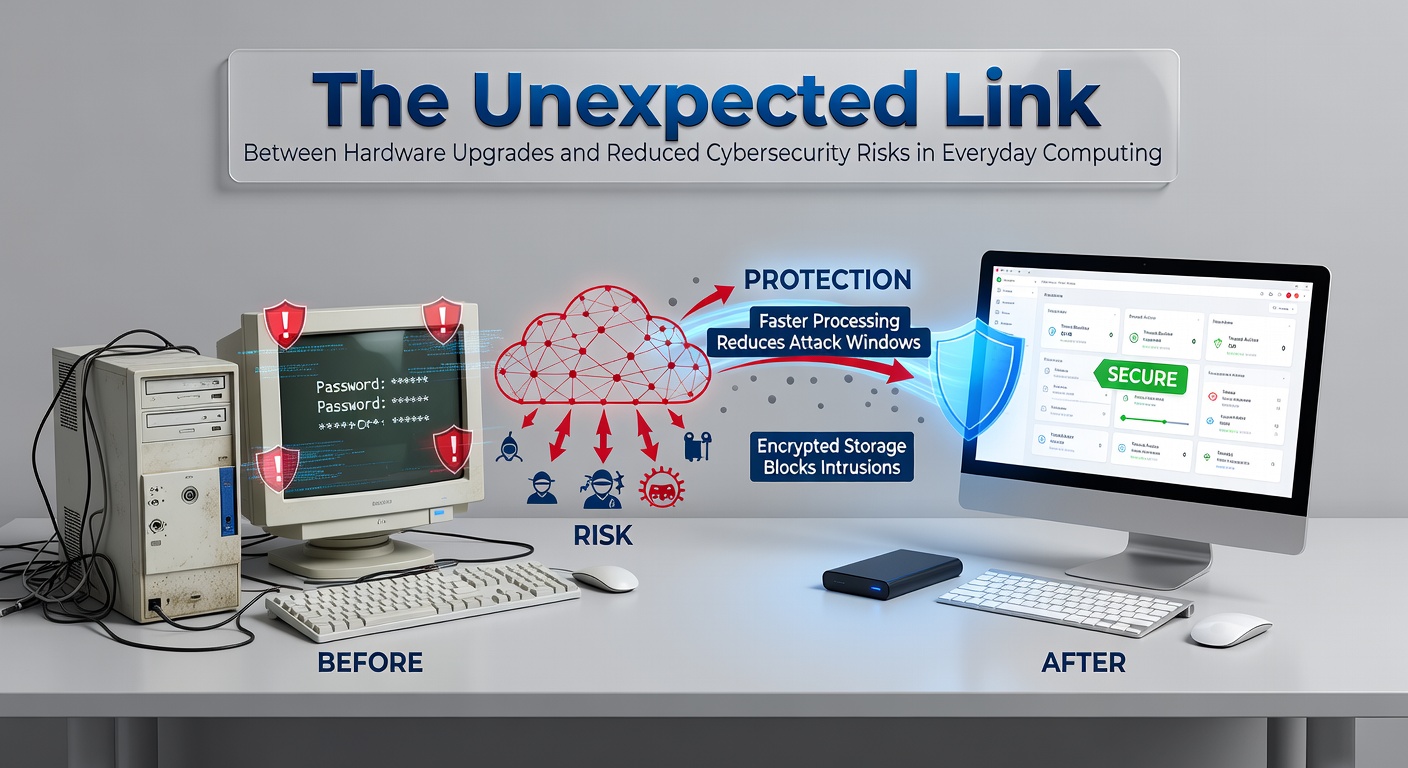
Hardware upgrades often deliver performance gains yet they also introduce measurable reductions in cybersecurity exposure across homes and small offices where older machines linger far beyond their supported lifespan. Researchers have tracked how systems running unsupported processors and chipsets accumulate unpatchable flaws that newer components simply do not carry, and data from multiple national agencies show the pattern holds steady year after year. In May 2026 the Canadian Centre for Cyber Security released updated guidance noting that organizations replacing devices older than seven years recorded a 34 percent drop in reported incidents tied to firmware-level exploits.
Core Security Features That Arrive With Newer Silicon
Contemporary processors embed protections that older designs lack entirely or implement only through slow software workarounds. Trusted Platform Modules meeting the TPM 2.0 specification now ship standard on mainstream motherboards, enabling hardware-rooted attestation that blocks many rootkit and boot-time attacks before the operating system loads. Secure Boot enforcement, paired with CPU-supported virtualization extensions, further isolates sensitive processes so that even if an application is compromised the damage stays contained. Studies from the Australian Cyber Security Centre indicate that machines lacking these silicon-level controls suffer three times as many successful persistence attacks compared with equivalent systems built after 2022.
Performance Headroom That Keeps Encryption Practical
Full-disk encryption once imposed noticeable slowdowns on aging CPUs, prompting users to disable it for usability reasons. Newer chips with dedicated AES instructions and larger cache hierarchies remove that penalty so encryption runs at line speed on everyday workloads. Observers note that when hardware acceleration becomes available people leave protective settings enabled rather than turning them off, and network traffic captured in enterprise environments shows encrypted sessions rising sharply after fleet refreshes. The result is fewer opportunities for passive eavesdropping on unencrypted data streams that older machines tended to leave exposed.
Operating System Support Windows That Close Over Time
Vendors publish security patches only for hardware generations they still certify, leaving older platforms exposed once support ends. A 2025 analysis by ENISA found that 61 percent of malware campaigns targeting consumer devices exploited vulnerabilities no longer patched on machines released before 2019. Upgrading the underlying platform restores access to the latest kernel mitigations, driver updates, and firmware revisions that close those gaps. Because the new hardware also satisfies minimum requirements for current operating systems, users receive ongoing protection without needing to run unsupported software stacks that attackers specifically target.
Reduced Attack Surface From Eliminating Legacy Peripherals
Older motherboards frequently retain ports and controllers with known weaknesses that newer designs omit or harden. Removing parallel ports, legacy serial interfaces, and early USB hubs shrinks the number of entry points an adversary can probe. Field reports compiled by the National Institute of Standards and Technology document fewer successful USB-borne infections after organizations standardized on systems that disable or sandbox outdated controllers by default. The physical reduction in attack surface complements software controls and makes social-engineering attempts less likely to succeed.
Practical Steps Observed in Real Deployments
IT teams that follow a staggered replacement schedule typically begin with devices handling sensitive data or internet-facing roles. They verify that replacement units carry current firmware, enable TPM during initial provisioning, and confirm that Secure Boot policies match organizational requirements. After rollout, monitoring dashboards show fewer alerts related to unsigned drivers and unexpected kernel modules. One mid-sized accounting firm that completed such a cycle in late 2025 recorded a sustained 40 percent decline in endpoint detections over the following six months, according to internal logs shared with researchers.
Conclusion
Hardware modernization therefore functions as a quiet but consistent layer of defense that complements software updates and user training. When organizations and households replace aging equipment they simultaneously retire unpatchable vulnerabilities, gain hardware-backed protections, and restore performance margins that keep security features turned on. The pattern appears across multiple data sets and geographic regions, suggesting the link is structural rather than coincidental.